
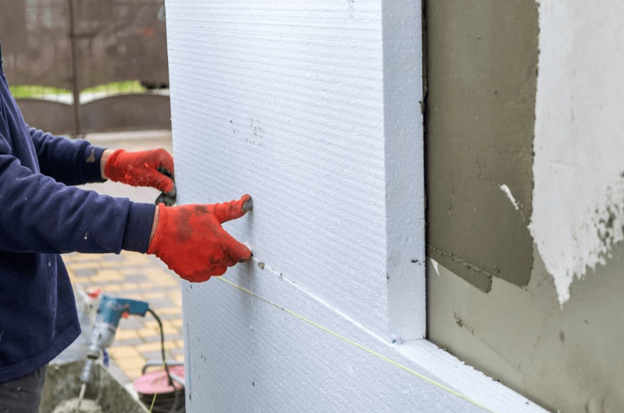
When you ask a builder what kind of board is underneath their plasterboard, they generally shrug. Expanded polystyrene insulation is often the quickest response. Few individuals know the difference between an excellent installation and a bad one since it has become a default decision rather than a conscious one. Small choices about grade, breathability, and details determine whether a wall functions well for the duration of the structure or subtly underperforms under the plaster, but the material is seldom given credit.
Picking the Right Grade
Standard white boards come in different density grades, and choosing the wrong one is a common mistake among self-builders who assume any board from the merchant’s yard will do. A floor meant to carry furniture needs a denser, more rigid grade than a board destined for a roof void where nothing will ever stand on it. Render systems are pickier still: a soft, low-density board will crack the finish coat within a season if installers skip the manufacturer’s spec sheet. None of this shows up in glossy brochures, but merchants who deal with call-backs know it well.
Why Some Boards Are Grey
Newer products infused with graphite particles, sold as grey or platinum boards, trap heat more effectively than the traditional white version, letting a thinner board do the same job as a bulkier one. Renovators working around tight window reveals or period properties with limited wall thickness lean on this constantly, since shaving a slim margin off a board’s depth can decide whether it fits cleanly or fights the existing frame. The white version remains the more common choice and performs perfectly well where depth isn’t a constraint, so the decision usually comes down to geometry rather than taste.
Breathability Counts
This material isn’t completely vapour-tight despite its closed-cell look, and older properties are more affected by this feature than newer ones. Wrapping solid-wall terraces with anything too impermeable may retain moisture that previously escaped innocuously through the brick since solid-wall terraces rely on some moisture circulation through their fabric. Because sealing a wall too firmly may solve a heat-loss issue while producing a damp one instead, specifiers upgrading historic dwellings consider this against entirely closed-cell solutions.
The Real Failure Point
Ask installers where insulation systems go wrong and almost none will blame the boards; they blame the joints between them. A continuous layer stops being continuous the moment boards are cut loosely, taped carelessly, or interrupted by brackets, joists and service penetrations nobody accounted for at the design stage. Thermal bridges this small can undo a surprising share of a wall’s theoretical performance, which is why junction detailing matters just as much as the expanded polystyrene insulation itself.
The Pest Problem
This material can attract unwanted attention from rodents and certain insects when left exposed below ground level or tucked behind cladding without a protective board in front of it. Pest controllers occasionally find tunnelling and nesting damage in basement insulation that was installed correctly from a thermal standpoint but left vulnerable at ground level, where gnawing pests can reach it freely. None of this is a reason to avoid the material entirely; it’s a reason to insist on proper protection rather than assume the insulation will look after itself.
Recycling, Realistically
The term “recyclable” obscures how that often occurs. Its size and low weight make routine collection unfeasible, and contamination from adhesives or render coatings further complicates recycling, therefore council kerbside dumpsters seldom ever take it. The practical approach involves manufacturers and specialised programmes that collect back clean offcuts and end-of-life boards, melt them down, and reconstruct them into new expanded polystyrene insulation. This closed loop has nothing to do with the residential trash can that most people associate with the term.
Conclusion
In order to properly specify expanded polystyrene insulation, one must go above the wording in the brochure and consider factors like grade, breathability, connection details, and protection at weak points. If you get those things correct, the material will vanish into the building’s structure for the duration of its existence. Even a well-chosen board may operate poorly for years if they make mistakes. The judgements made surrounding the boards are often the issue, not the boards themselves.