
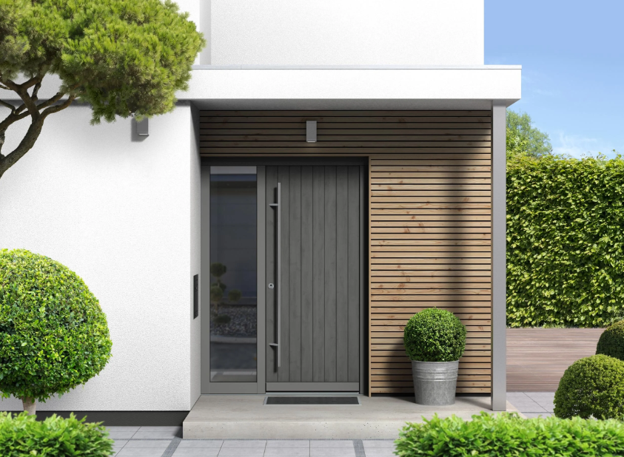
There is a entrance doors specific kind of judgement that happens in the few seconds someone waits on a doorstep, and almost nobody is consciously aware they are making it. The door has not opened yet. There is no interior to see, no furniture, no layout to assess. And yet by the time it does open, an impression has already formed care or neglect, attention or indifference based entirely on a slab of material that most homeowners think about for about ten minutes before settling on whatever color matches the brick. Entrance doors do an enormous amount of unconscious communication, and the gap between treating that door as an afterthought and treating it as a genuine decision becomes obvious the moment someone is standing in front of it, waiting.
The Door Finishes a Sentence the Rest of the House Started
Most homeowners pour real thought into their interior furniture, paint coolers, the layout of a living room and then treat the front door as a fairly mechanical decision, something to be solved rather than designed. This creates a strange disconnect that visitors register without being able to name it. A beautifully presented interior behind a tired, mismatched front door feels like a book with a damaged cover the content might be excellent, but something about the framing undermines the experience before it even begins. The reverse is just as telling. A door that has clearly been chosen with the same intention as everything else in the home sets an expectation of care that primes a visitor to notice the good things inside rather than hunting for flaws.
Entrance doors: Material Choice Is a Bet on a Specific Climate
Choosing a door material solely on how it appears in a showroom, without considering the unique light exposure and weather a particular entry really confronts, is a wager that frequently does not pay off. A wooden door on a north-facing entry that gets pounded by sun for much of the day will weather and fade substantially quicker than the identical door nestled beneath a deep porch on a shady side of the house. Composite doors manage the same severe exposure with significantly less ongoing upkeep, which matters immensely for homeowners who do not want to be repainting a door every couple of years. Entrance doors purchased without this climate-specific consideration tend to appear worn much before their structural life is really ended, which is a truly preventable form of disappointment.
Security Decisions Get Made by Default, Not by Design
Most people assume a door is secure simply because it is a door, without examining what is actually backing up that assumption. A beautifully designed door fitted into a poorly reinforced frame, or paired with glazing positioned close enough to a lock that it creates an obvious point of vulnerability, looks entirely solid right up until someone actually tests it. Entrance doors chosen purely for visual appeal, with security treated as something the door automatically provides rather than something specifically verified, create exactly this kind of false confidence until the moment it matters, and useless precisely then.
The Parts You Touch Reveal More Than the Parts You See
A door slab can be beautifully finished and still feel cheap the instant someone grips a flimsy handle or hears a lock rattle slightly when it turns. Hardware is where the tactile experience of a door actually lives, and it is consistently the element people spend the least time choosing. A handle that feels solid and a lock that turns with quiet precision do more to convince someone of a door’s quality, in the actual moment of using it, than the door slab itself ever will. Mismatched or undersized hardware on an otherwise excellent door undercuts the impression the door was supposed to create.
Draughts Get Blamed on the Wrong Culprit
A surprising number of homeowners spend money chasing draughts around windows and skirting boards while the actual source sits at the front of the house, in a door that was never properly sealed against its frame. This misattribution happens constantly, because nobody suspects the entrance door specifically until someone finally checks it directly. Addressing the door’s seal and insulation at installation, rather than retrofitting a fix once the drought has already been driving up heating costs for a season or two, avoids a problem that is otherwise oddly difficult to trace back to its real source.
Conclusion
The entrance doors does a surprising amount of work for something most people barely think about. Entrance doors chosen with genuine attention to climate-appropriate material, real security rather than assumed security, hardware that feels as good as it looks, and proper sealing reward homeowners with something that holds up, both in appearance and in the impression it creates, for years rather than months. That level of attention is rarely expensive to get right at the outset, and it is considerably more expensive to fix once it has already gone unnoticed for too long.